



Last Updated on October 25, 2025 by Tony
Hello, I’m Tony from Keystone Comfort Solutions. For this article, I want to step away from talking about efficiency, costs, and boiler models for a moment and have a serious chat about something far more important: your family’s safety. There is a hidden danger in our homes that we all need to be aware of, and that is carbon monoxide.
As an engineer who has worked in thousands of homes across Epsom and Surrey for over 30 years, I consider it my primary professional and moral responsibility to protect my clients from this risk. My promise in this guide is not to scare you, but to give you the clear, unvarnished facts about carbon monoxide (CO). I want to explain what it is, how to recognise the signs of a problem, and most importantly, how the annual boiler service is the single most effective action you can take to prevent it. When it comes to something this serious, knowledge, not fear, is your best protection.
What is Carbon Monoxide (CO)? The “Silent Killer” Explained
Carbon monoxide is a gas that is produced when a fuel like natural gas, oil, coal, or wood does not burn completely. The reason it is so dangerous is because it is completely invisible to our senses. You cannot see it, you cannot smell it, and you cannot taste it. This is why it is often tragically referred to as the “silent killer.”
It can be produced by any fuel-burning appliance that is not working correctly. This includes not just your boiler, but also gas fires, gas cookers and hobs, log burners, and even a blocked chimney. When you breathe in CO, it enters your bloodstream and prevents the red blood cells from carrying oxygen around your body. This lack of oxygen causes the body’s cells and tissues to fail and die.
Recognising the Danger: The Symptoms of CO Poisoning
The most crucial thing to know about the symptoms of CO poisoning is that they are notoriously easy to mistake for other, more common illnesses like the flu, a bad hangover, or simple fatigue. This is what makes it so insidious.
- Low-Level Exposure Symptoms: If a faulty appliance is slowly leaking a small amount of CO into your home, you and your family might experience:
- Tension-type headaches: This is the most common and often the first symptom to appear.
- Nausea and stomach pain: Feeling sick and queasy for no apparent reason.
- Dizziness and feeling light-headed.
- General lethargy and tiredness: Feeling exhausted and ‘out of sorts’ all the time.
- The Telltale Clue: The single biggest clue that your symptoms might be caused by CO is if you notice that they get better when you leave the house (for example, when you go to work or out for the day) and then come back when you return home. If multiple people in the house (and even pets) are feeling unwell with similar symptoms at the same time, this is another major red flag.
- High-Level Exposure Symptoms: A larger leak of CO can be catastrophic very quickly. The symptoms can include severe confusion, vertigo (a feeling like the room is spinning), loss of coordination, collapse, and ultimately, loss of consciousness.
- What to Do if You Suspect CO Poisoning: If you have even the slightest suspicion that you or your family are being affected by CO, you must ACT IMMEDIATELY. Do not hesitate.
- Turn off all your fuel-burning appliances if it is safe to do so.
- Open all your windows and doors to ventilate the property.
- Get everyone out of the house into the fresh air.
- Call 999 for medical attention and tell them you suspect carbon monoxide poisoning.
Your Boiler’s Role: How Things Can Go Wrong
Your boiler is designed to be an incredibly safe appliance, but like any machine, it can become dangerous if it is not looked after properly. There are three main ways a boiler can start to produce carbon monoxide.
- Problem #1: Poor Installation or Maintenance. This is the number one cause. A boiler that was badly installed by an unqualified person, or one that has not been serviced for many years, can develop faults that lead to incomplete combustion.
- Problem #2: A Blocked Flue or Chimney. The flue is the boiler’s exhaust pipe, which is designed to safely expel the products of combustion to the outside. If this pipe becomes blocked by a bird’s nest, leaves, or even if it has been installed incorrectly, the dangerous fumes have nowhere to go and can seep back into your home.
- Problem #3: Inadequate Ventilation. Your boiler needs a good supply of oxygen to burn its fuel cleanly and completely. If the vents or air bricks that supply air to your boiler are blocked or covered over (perhaps during building work), it can become starved of oxygen and start to produce CO.
You can also look for physical warning signs on your boiler. Look out for sooty stains or black marks on or around the appliance, a lazy, yellow-orange coloured flame instead of a crisp blue one, or an unusual amount of condensation on the inside of your windows.
Your First Line of Defence: The Annual Boiler Service
I want to be absolutely clear about this: a professional boiler service is a safety inspection first, and a maintenance check second. While we talk a lot about efficiency and preventing breakdowns, our primary, non-negotiable job as Gas Safe registered engineers is to ensure that your boiler is operating safely.
Here is how we actively check for and prevent the risk of CO during a service:
- The Flue and Ventilation Check: One of the very first things we do is a full inspection of your boiler’s flue. We check that it is secure, sealed correctly, and that the terminal outside is completely clear of any obstructions. We also check that the boiler has adequate ventilation, ensuring it can ‘breathe’ properly.
- The Internal Inspection: We take the boiler’s casing off and carefully inspect the integrity of the combustion chamber and its seals. We are looking for any signs of wear, cracks, or corrosion that could allow fumes to escape.
- The Combustion Analysis: This is the ultimate and most important safety test. We use a highly sensitive and expensive piece of equipment called a Flue Gas Analyser. We insert a probe into the flue, and the analyser gives us a precise, digital reading of the gases inside. It tells us the exact ratio of gas to air and, crucially, it measures the level of carbon monoxide in the exhaust fumes, often in parts per million. This test provides definitive proof that your boiler is burning its fuel safely and correctly. Any reputable engineer will consider this an essential and non-negotiable part of any boiler service.
Your Second Line of Defence: The CO Alarm
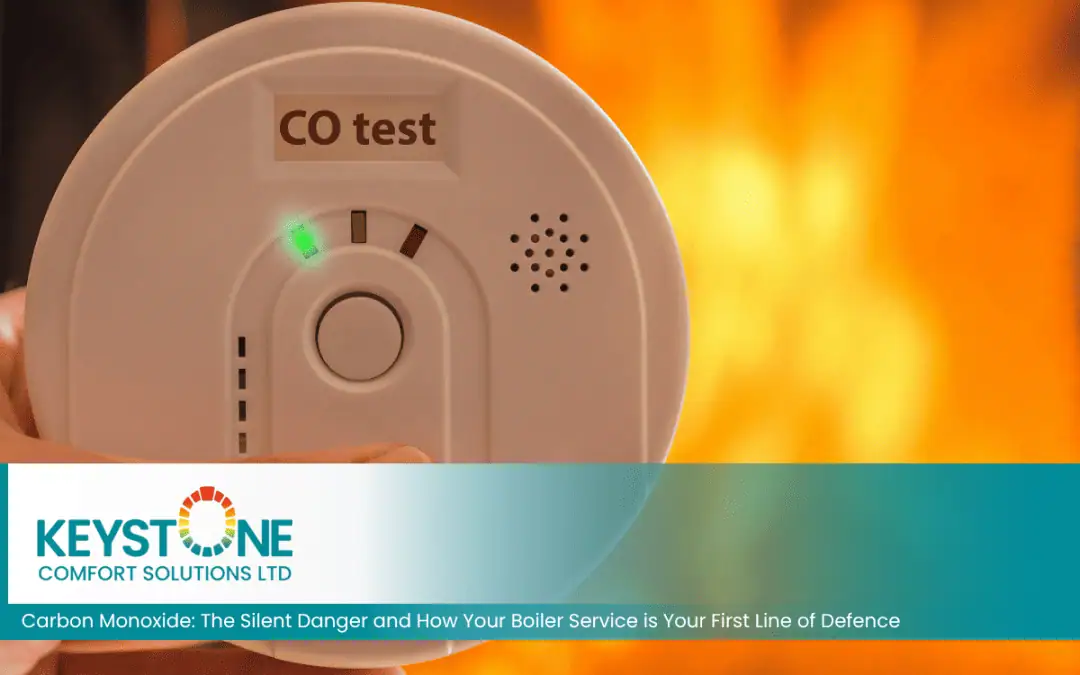
A professional annual service is your first and most important line of defence. Your second line of defence, and an essential back-up for every home, is an audible carbon monoxide alarm.
It is vital to understand that a CO alarm is not a substitute for a service. A service prevents the problem from happening in the first place; the alarm is there to warn you if, for any reason, a problem develops between services. Make sure you buy an alarm that is marked with the British Standard EN 50291 and has the British Kitemark. Fit it in the same room as your boiler, at head height (on a shelf or wall), about 1-3 metres away from the appliance. Remember, a CO alarm is completely different from a smoke alarm, and you need both. And just like a smoke alarm, you should test it regularly and replace it according to the manufacturer’s instructions (usually every 5-7 years).
Our Commitment to Your Safety at Keystone Comfort Solutions
As a Gas Safe registered engineer, gas safety is a legal and moral responsibility that I, and my entire team, take incredibly seriously. We treat every service we carry out in homes across Surrey as a comprehensive safety inspection. Your family’s wellbeing is our absolute priority, and we will never, ever cut corners when it comes to ensuring your appliances are safe.
Your Carbon Monoxide Safety Checklist: A Summary
- SERVICE: Get all your fuel-burning appliances – including your boiler, gas fire, and cooker – serviced every year by a Gas Safe registered engineer.
- ALARM: Fit an audible CO alarm that meets the EN 50291 standard and test it regularly.
- KNOW THE SYMPTOMS: Be aware that headaches, nausea, and dizziness can be signs of CO poisoning, and be alert to the telltale clue of symptoms improving when you leave the house.
Frequently Asked Questions from Surrey Homeowners
I have an electric boiler. Do I still need to worry about CO?
No. Carbon monoxide is only produced by the incomplete burning of carbon-based fuels like gas, oil, or wood. Electric heating systems cannot produce carbon monoxide.
My boiler is brand new. Is there still a risk of CO?
A brand-new boiler that has been correctly installed by a Gas Safe registered engineer is extremely safe. However, a service is still required after 12 months. This is to ensure it has ‘bedded in’ correctly and is still operating to the manufacturer’s safety specifications, and it is also a requirement to keep your warranty valid.
How long do CO alarms last before they need replacing?
The sensor inside a CO alarm has a finite life. Most models need to be replaced every 5 to 7 years. They will usually have a ‘replace by’ date printed on them, and many will start to chirp when they are reaching the end of their life.
Does my landlord have to provide a CO alarm?
Yes. Since October 2022, the law requires that landlords must ensure a carbon monoxide alarm is fitted in any room that contains a fixed combustion appliance (like a boiler or a gas fire) in their rental properties. They are also responsible for ensuring the alarms are in proper working order at the start of each new tenancy.
Recent Comments